


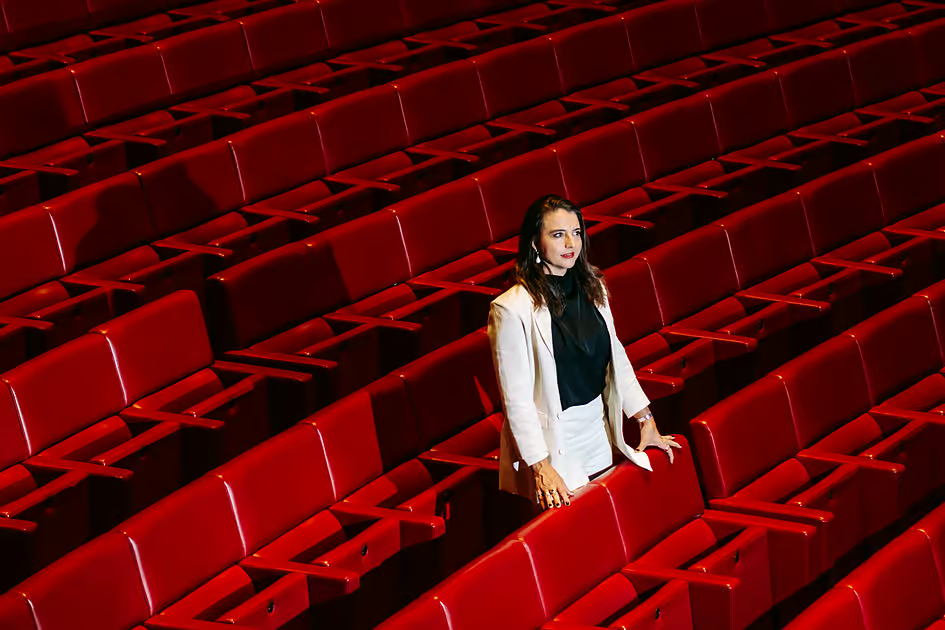
For a city that is still writing much of its cultural story in real time, Dubai Opera has spent the past decade becoming one of its most recognisable chapters. It’s where families have brought children to see their first ballet, where music fans have traded headphones for the electricity of a live orchestra and where performers — from global names to homegrown talents — have walked onto the stage with the feeling that they have arrived.
For Lara Ewing, the newly appointed Head of Dubai Opera, the decade-long evolution is also personal. She grew up between Bahrain and Dubai, went to school in the UAE and first joined Dubai Opera in March 2016, before the venue had even opened its doors. “I started at Dubai Opera in March 2016, before we opened,” she tells Khaleej Times, ahead of the venue’s 10th anniversary celebrations.
She spent five years at the venue before leaving after Covid. Four months into her current role as Head of Dubai Opera, she is taking charge at what feels like a defining moment for the institution, with its landmark anniversary and the beginning of a new chapter for a cultural space that has grown alongside Dubai itself.
A venue built alongside a city
When Dubai Opera opened in 2016, it came with a promise that felt significant for a young, rapidly evolving city. Dubai had long had grassroots creative communities, independent arts spaces and an appetite for entertainment. But a major dedicated theatre that could host large international productions at this scale was something else entirely.
“For me, growing up in the region, this is what I would have loved,” Ewing says. “There was a lot of grassroots arts going on when I was at school, but to have a proper theatre, a venue, a space where we could have international productions was really exciting. I was proud to be a part of that.”
The city around it has changed dramatically in the years since. So has the venue’s role within it.
Dubai Opera has now welcomed more than 1.5 million visitors, hosted around 6,500 artists and staged more than 2,500 performances. The numbers tell the story of a city that has embraced live culture as part of everyday life, not merely as an occasional luxury.
But the more interesting story lies in what those figures represent — an audience that has grown more curious. “It just shows how crucial arts and culture is in a thriving culture, a thriving community,” Ewing says.
“Obviously, here in Dubai, we appreciate the incredible international flavours that we get in,” she says. “But I also think what it shows is that, over time, we’ve had a lot more regional voices come into that mix and a lot of appreciation for that, which is really interesting.”
That shift is reflected in how Dubai Opera is opening its anniversary season. Rather than looking only outward, the venue will open with the UAE National Orchestra, regional opera talent and a newly commissioned work by composer Mohamed Medhat, combining symphonic music with Arabic instruments.
According to Ewing, it stands as a meaningful marker of how far the cultural conversation has moved in 10 years. “When we first opened, we had Plácido Domingo, we had Trieste Opera. This year, we’re opening the season with a brand-new piece we’ve commissioned for the UAE National Orchestra. We’re super excited to have the world premiere for it.”
More than a hall with a stage
There’s a particular ritual of going to the theatre. The lights dim. The chatter fades away. The curtain begins to rise. For the next hour or two, strangers sit together and agree to be transported somewhere else.
It’s a feeling Ewing returns to often, especially as live entertainment continues to compete with an endless supply of content at home. “You can watch a musical at home now on YouTube, but it feels totally different to how it feels in the auditorium, sitting around people,” she says. “When the lights go down and the curtain starts coming up, it’s just that feeling of anticipation that you don’t get. It’s a whole other world.”
That shared feeling has become increasingly important in a city as fast-paced as Dubai. The venue has remained a place for joy and curiosity but also for a kind of collective togetherness.
During more uncertain periods earlier this year, Ewing says, audiences still showed up. There was a visible desire to be around other people rather than retreat into private routines. “People still felt really comfortable coming together,” she says. “Because, ultimately, they want that togetherness and to experience something joyful or interesting or funny or challenging all together.”
Over the years, performers from around the world have arrived in Dubai, sometimes for the first time, and gone home with a changed view of the city, says Ewing. “A lot of them have never been to Dubai before, or the region,” she adds. “They come over here, experience this venue, see the hospitality that we have here in Dubai and then go back to wherever they came from and spread that message.”
A season for every kind of Dubai resident
The challenge of programming Dubai Opera is also what makes it exciting, says Ewing. The city is not a single audience. It is Emirati families, longtime residents and new arrivals. It is people who grew up with opera, people who have never seen a ballet, Hindi musical fans, Arabic music lovers, comedy regulars and curious first-timers who may only be there because a friend convinced them to buy a ticket.
“We really want to appeal to the diverse range of people who are here,” she adds. “We’re here for the residents of Dubai predominantly. So, it’s really important that we provide something that is going to be enjoyable for a wide range and that nobody feels left out.”
A guest may arrive for The Nutcracker because it is a childhood tradition, then find themselves returning for a contemporary dance performance, an opera or a piece of theatre they would not otherwise have considered.
The anniversary gala is an example of that, says Ewing, adding that it’s deliberately designed as a mix of well-known Western operatic classics, familiar Arabic songs and a contemporary dance performance.
“There might be people who come specifically for the well-loved Arabic songs and they’ll listen to some of the Western opera and be like, ‘Oh, actually, we really enjoyed that,’” she says. “It’s a soft way of exposing people to different genres and art forms.”
Making culture feel less intimidating
For all its grandeur, Dubai Opera does not want to be a venue people feel they need to “dress up” for, literally or culturally. Theatres can still feel intimidating for people who have never been inside one. Movies have taught audiences to imagine tuxedos, formal etiquette and an unwritten rulebook one may not understand.
But Ewing says she wants the experience to feel warmer and more accessible than that. “We want to be a space that is warm, that’s welcoming and that people feel comfortable and excited coming to.”
That intention is extending into education, with plans to work with incoming companies and artists on workshops that support local creatives, alongside pre-performance talks that provide useful context around unfamiliar art forms.
“There might be an opera, for example, and you might think, ‘What’s the story? Will I like opera? Do I like opera?’” Ewing says. “But if you know the story and you understand a bit more about the art form, then it makes it more accessible for you.”
The stage that says, ‘I made it’
Perhaps the clearest sign of Dubai Opera’s growing stature is how artists talk about it. For many performers in the city, getting onto that stage has become a personal landmark. It is the place they hoped to reach while building an audience in smaller rooms, cafes or local venues. It carries prestige, but also recognition. An affirmation that their work has travelled far enough to stand in one of Dubai’s most visible cultural spaces.
Ewing recalls a recent moment that crystallised that feeling. Egyptian comedian Mina Nader sold out two shows at the venue, later reflecting on how far the journey had taken him. A decade earlier, he had performed in a room for 100 people, with only 36 attending. At Dubai Opera, he performed to an audience of 3,500.
For many artists, she says, performing at the venue carries a definitive sense of, “I made it.”
And ten years in, the venue is no longer trying to prove that Dubai belongs on the global cultural circuit. It has helped shape that circuit in its own way, balancing international names with regional ambition and a growing confidence in what the city can bring to the stage.
“If we just focus on what’s best practice internationally, then we’ll lose so much because there’s such rich heritage here,” Ewing says. “So, the aim is to learn from what works, but also draw from the traditions and heritage here, while keeping an eye on the future.”
Source: Khaleej Times
