


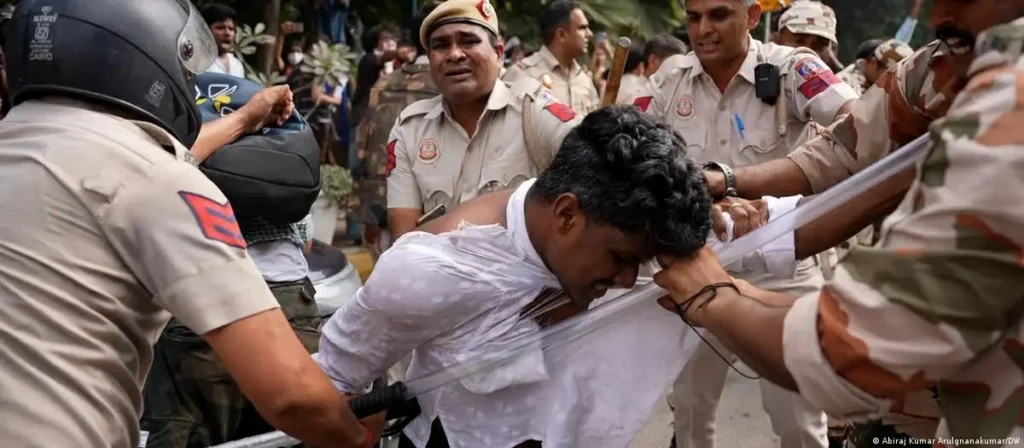
NEW DELHI — Leaders of India’s “cockroach” movement have vowed to press on with their protests, hours after police in New Delhi unleashed brutal force at young protesters angry over what they say is Prime Minister Narendra Modi’s manipulation of the country’s electoral system, bashing them and dragging them to detention by the thousands.
The rallies in the capital come after weeks of opposition mobilization following allegations of misconduct during a nationwide voter roll revision that critics say could benefit Modi’s ruling Bharatiya Janata Party (BJP).
The Election Commission of India, which oversees the voting process in the world’s most populous nation, has denied wrongdoing.
Thousands of protesters have been detained since Saturday, according to the group and media reports.
Phones in hand, the youth have documented the harsh treatment, down to the dirty condition of the police stations they were held in. They found ways around an internet shutdown in central New Delhi to flood social media with content undermining the image of Modi.
Abhijeet Dipke, founder of the Cockroach Janta Party (CJP), and two other leaders were released Sunday, one day after they were detained when they landed in New Delhi to take part in a protest at the Jantar Mantar site in the heart of the city.
“We will not back down,” Saurav Das, another top CJP leader, told reporters after his release.
“We urge people to come out and carry out peaceful protests,” he added, vowing to continue until Chief Election Commissioner Gyanesh Kumar resigns.
Soon after his release, the CJP’s Dipke took aim at Modi, calling him “an embarrassment to India.”
“Never has this country seen a bigger coward and bully,” he said in a social media post.
Reporters Without Borders (RSF) said at least 16 journalists had also been detained, calling the police actions “unacceptable.”
“Covering events of public interest is not a crime,” RSF said in a statement. “It is their job.”
Ahead of Saturday’s rally, authorities mounted a sweeping security operation across the capital, shutting down metro stations and more than 200 trains while imposing a ban on public gatherings in several areas.
Smaller rallies took place in Delhi on Sunday. Dozens of protesters were detained near Jantar Mantar, which remained blocked off, AFP reported.
Thousands of police and paramilitary personnel remained deployed on Sunday, but metro stations reopened and previously restricted mobile services were restored.
The Supreme Court, hearing petitions challenging Saturday’s detentions and other security measures, directed the authorities to ensure protesters gathering peacefully were not detained illegally.
“Detention shall only be after following a legal procedure,” Justice Joymalya Bagchi said in oral remarks.
The court also ordered authorities to ensure there was no disruption to Internet connectivity as seen on Saturday.
The CJP has emerged as one of the most significant political challenges to Modi during his third term in power, winning millions of followers on social media since it was launched in May as a satirical party.
The revision of voter rolls resulted in more than 133 million names being removed from electoral lists, according to media reports.
Critics say the measure has disproportionately affected minorities, particularly Muslims, potentially benefiting the Hindu nationalist BJP.
Election authorities say the move was aimed at eliminating duplicate, deceased and fraudulent entries.
The detention of protesters on Saturday triggered sharp criticism and accusations that Modi’s government was stifling dissent.
The UN human rights office called for the immediate and unconditional release of all those “arbitrarily detained” in Delhi — a comment the Indian government called “misplaced.”
Rahul Gandhi, leader of the opposition Congress party, said he was planning to march to the Supreme Court on Monday with “every single person who believes in democracy.”
“There is nothing to fear,” he said on social media. “These cowards can do absolutely nothing to us.”
Modi has long cultivated an image abroad as the popular elected leader of the world’s largest democracy, a sober voice of peace in a world of violence.
He has balanced that role at home in India with another penchant, as a strongman whose lieutenants have wielded the arms of the state at dissenters, exploiting an increasingly pliant legal system and bureaucracy. These efforts have undercut and splintered the opposition, cowed independent media and jailed activists.
Modi’s balancing act broke down as violent scenes across the capital city were beamed to screens around the world, exposing the rough edges of his rule and the limits of his formula for maintaining power, according to The New York Times.
“The old playbook has become old, it’s tired, it doesn’t work,” said Gyan Prakash, a Princeton University historian who has written extensively about the Indian government’s descent into authoritarian rule in the 1970s. “And so what do they have now left? They have the police.”
Modi has remained characteristically mum on the protests. His official social media accounts instead posted birthday greetings and festival wishes, keeping with his practice of associating himself only with positive things.
Source: Saudi Gazette
