


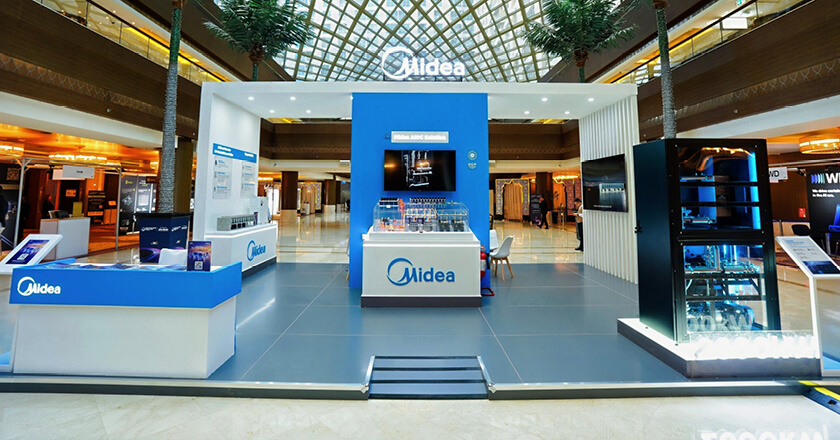
Data Center World Middle East 2026 took place on 17–18 November at the Dusit Thani Hotel in Abu Dhabi. Midea exhibited under the theme “Cooling AI. Delivering Certainty”.
The conference program covered AI cooling, mixed rack densities, cooling supply chains in the Gulf, and data centre expansion in pursuit of net-zero goals. One technical panel at the conference addressed one of the Gulf region’s most pressing infrastructure questions: how to design a single facility that accommodates 10 kW, 30 kW and 100 kW+ racks. The answer involves more than adding cooling capacity. It requires rethinking how air and liquid cooling coexist in the same plant and how that plant performs under the sustained high ambient temperatures typical of the Middle East.
AI accelerator racks generate thermal loads several times higher than conventional compute or storage cabinets. Cooling systems designed for uniform, moderate heat loads across a facility floor cannot simply be scaled up to handle clusters of high-density racks interspersed with standard equipment. High outdoor temperatures in the Gulf can also limit opportunities for free cooling and increase reliance on mechanical refrigeration.
To address these challenges, Midea showcased its Air-Liquid Converged Full-Stack AIDC Cooling Solution.
One cooling architecture for different rack densities
Midea’s Air-Liquid Converged Full-Stack AIDC Cooling Solution uses a shared cooling source for both air and liquid cooling. In a facility that houses conventional IT equipment alongside high-density AI racks, cooling requirements can vary from one zone to another. Operators can retain air cooling where it meets the load and use liquid cooling in zones with higher heat loads. The shared architecture lets operators adjust how much cooling each method provides as the facility’s workloads and rack densities change.
Midea’s portfolio covers the cooling chain from the plant to the distribution and air-side equipment. The chiller range includes both air-cooled and water-cooled options, with magnetic bearing centrifugal chillers and screw chillers. Hydraulic modules and coolant distribution units (CDUs) support fluid distribution, while fan walls are among the options for air-side cooling. Midea offers these components through a single delivery package, so operators can source equipment for both cooling methods from one provider and simplify system integration.
A primary cooling source designed for Gulf conditions
Midea highlighted the AirBoost Inverter Air-Cooled Screw Chiller as the flagship cooling source for this configuration. The chiller operates reliably at an ambient temperature of 52°C and supports a maximum ambient temperature of 55°C. It is designed to restart within 120 seconds after power is restored, helping reduce the time it takes to resume cooling after an outage.
AirBoost uses R1234ze(E), a refrigerant with a global warming potential (GWP) below 1. To address corrosion risks at coastal and industrial sites, Midea uses a rare-earth aluminium alloy microchannel heat exchanger and cites 9,000 hours of salt spray testing for the component. Midea also offers optional TCP and E-coating treatments for installations that require additional corrosion protection.
Two CDU options for different needs on the secondary side
Midea’s Ultra-High-Capacity CDU provides up to 2.6 MW of cooling capacity per unit for high-density AI and GPU deployments. It connects the facility cooling loop to the liquid cooling circuit serving IT equipment. For operators planning a large AI zone, its capacity is a concrete starting point for sizing the distribution system against the expected load.
For air-liquid hybrid deployments, Midea’s Magnetic CDU integrates the pump, piping, and valves into a single unit and supports containerized prefabrication. This design simplifies on-site installation and can shorten time to market by 20%.
What the shift to AI means for project delivery
At DCWME, Midea’s keynote explored how the shift from cloud computing to AI is changing data centre cooling. A technical panel brought that question down to the rack level, looking at how one facility can accommodate racks drawing 10 kW, 30 kW, and 100 kW or more. Midea’s roundtable looked at another side of the same challenge: the supply chain and delivery issues facing cooling projects in the Gulf.
The evolution is visible in the cooling architecture itself. Conventional data centres could rely on air cooling as the default. As AI workloads raise rack densities, operators face a choice: build separate air and liquid cooling plants, or design a converged architecture where both draw from the same source. Midea’s approach is the latter. A shared air-cooled chiller plant feeds both fan walls and CDUs, so operators do not have to maintain parallel systems or redesign the facility plant when the balance between air-cooled and liquid-cooled racks shifts.
That convergence is where reliability and delivery certainty intersect. On the primary side, equipment rated for stable operation at 52 degrees Celsius ambient and 120-second post-outage restart addresses the Gulf’s two most persistent operating risks. On the secondary side, adjustable coolant supply temperatures from 20 to 45 degrees Celsius and single-unit CDU capacities up to 2.6 MW give operators room to match the cooling system to whatever chip mix the facility runs today, and to adapt as that mix changes.
Midea’s global manufacturing base and delivery network support the speed at which Gulf data centre projects are moving. Spare parts coverage spans 34 countries with same-day delivery capability, and local service is available through 193 service points across 29 countries. For operators planning large-scale builds in the region, the ability to source the full cooling chain from a single manufacturer, from chillers and hydraulic modules through CDUs and fan walls, can reduce integration complexity and shorten project timelines.
For Midea, that is the practical meaning of “Certainty for Every Token.” Not certainty as a slogan, but as a set of engineering and delivery commitments: equipment that holds capacity in sustained heat, recovers quickly after disruption, and arrives as a coordinated system rather than a collection of components from different suppliers.
Image Credit: Midea
Source: Tahawul Tech
