


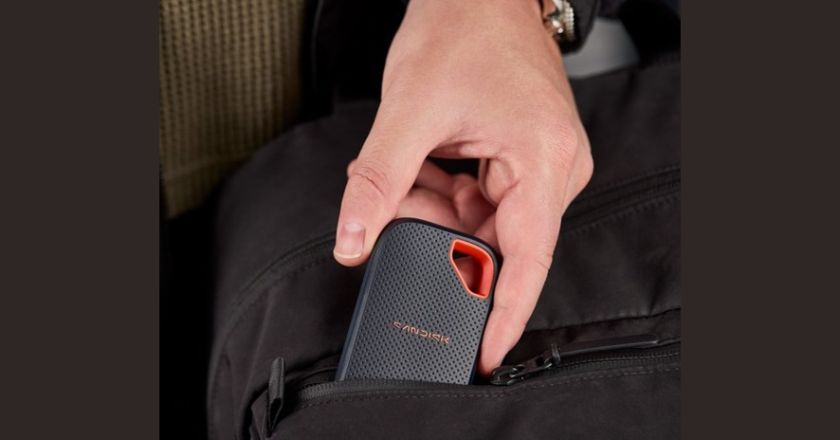
A smaller design, up to 2,000MB/s read speeds and password protection give the SANDISK Extreme Portable SSD practical appeal for mobile professionals, although connection requirements deserve close attention.
Large photo libraries, video projects and presentation files quickly expose the limitations of everyday storage. SANDISK’s Extreme Portable SSD addresses those demands with a compact design and a higher advertised read speed, targeting professionals and creators who regularly move substantial amounts of data.
The proposition is straightforward: carry more, spend less time transferring files and add some protection against the knocks and spills of working on the move. Getting the maximum advertised performance, however, requires a compatible USB connection.
This assessment is based on Sandisk’s supplied reviewer’s guide and published specifications. Performance figures are manufacturer claims rather than independently measured results.
Portability is one of the drive’s clearest strengths on paper. Measuring 85 × 51 × 9.8mm and weighing 46.9g, SANDISK Extreme Portable SSD should fit comfortably into a pocket or a small compartment in a laptop bag. Sandisk describes the design as up to 10 per cent smaller than its previous generation.
Capacity options span 1TB, 2TB and 4TB, giving buyers a choice between carrying active projects and maintaining a larger travelling library. Actual usable storage is lower than the labelled capacity.
For photographers, content producers and business travellers, the appeal lies in keeping substantial files close to hand without adding much weight. Choosing the right capacity will depend on how quickly those files accumulate, particularly when video becomes part of the workload.
Performance and everyday practicality
Sandisk quotes read speeds of up to 2,000MB/s over USB 3.2 Gen 2×2, a 20Gbps interface. The specification is attractive for users moving large files, but a USB-C connector alone does not establish that a computer supports the required interface.
Buyers should check their device’s port specifications before treating the headline figure as an expected result. Sandisk explicitly states that a USB 3.2 Gen 2×2 20Gbps connection is needed to obtain full quoted performance.
Read and write speeds also need to be distinguished. The 2,000MB/s figure applies to reading data; Sandisk states that write speeds are lower without specifying a maximum in the supplied guide. Copying footage onto the drive should therefore not be assumed to match its advertised read performance.
Sandisk also claims the drive can move up to 1,000 high-resolution photographs in under 60 seconds. The result comes from internal testing using PNG files averaging 30.4MB each. Different file sizes, host devices and usage conditions will influence actual transfer times.
Sustained performance remains an unanswered question in this assessment. The guide describes the manufacturer’s benchmark setup, but independent testing would be needed to establish how the drive behaves during lengthy transfers or repeated large writes.
An IP65 rating and claimed drop protection of up to three metres strengthen its suitability for travel and location work. Such protections offer a useful margin against everyday mishaps, although water resistance should not be interpreted as permission to submerge the device. Sandisk also states that the drive must be clean and dry before use.
Password protection using 256-bit AES encryption adds another practical feature for users carrying private material. The supplied guide lists support for Windows 10 or later and macOS 13 or later, with a software download required. Maintaining a separate backup remains essential, regardless of the drive’s physical protection or security features.
Sandisk lists compatibility with a range of USB-C smartphones, laptops and tablets. Its specifications identify Windows 10 or later and macOS 13 or later for the drive, including Time Machine compatibility.
The accompanying app has separate requirements, covering Android 8 or later, macOS 11 or later, and Windows 10 and 11. Buyers should distinguish basic storage compatibility from access to particular software features. Support for connecting a drive does not automatically mean every backup or security function is available on every device. A five-year limited warranty rounds out the package. UAE pricing was not included in the supplied material, leaving value for money dependent on the local asking price and capacity selected.
Verdict
SANDISK Extreme Portable SSD presents a convincing specification for professionals who need compact storage with useful capacity, password protection and some resilience against everyday accidents.
Its strongest fit is a buyer whose computer supports USB 3.2 Gen 2×2 and whose workload involves regularly reading or moving large files. Users with slower connections may still appreciate the size and protection, but should weigh the price against the performance their equipment can support.
The specification makes this a promising portable storage option. A definitive performance recommendation would require hands-on testing of sustained transfers, write speeds, and operating temperatures.
Source: Tahawul Tech
